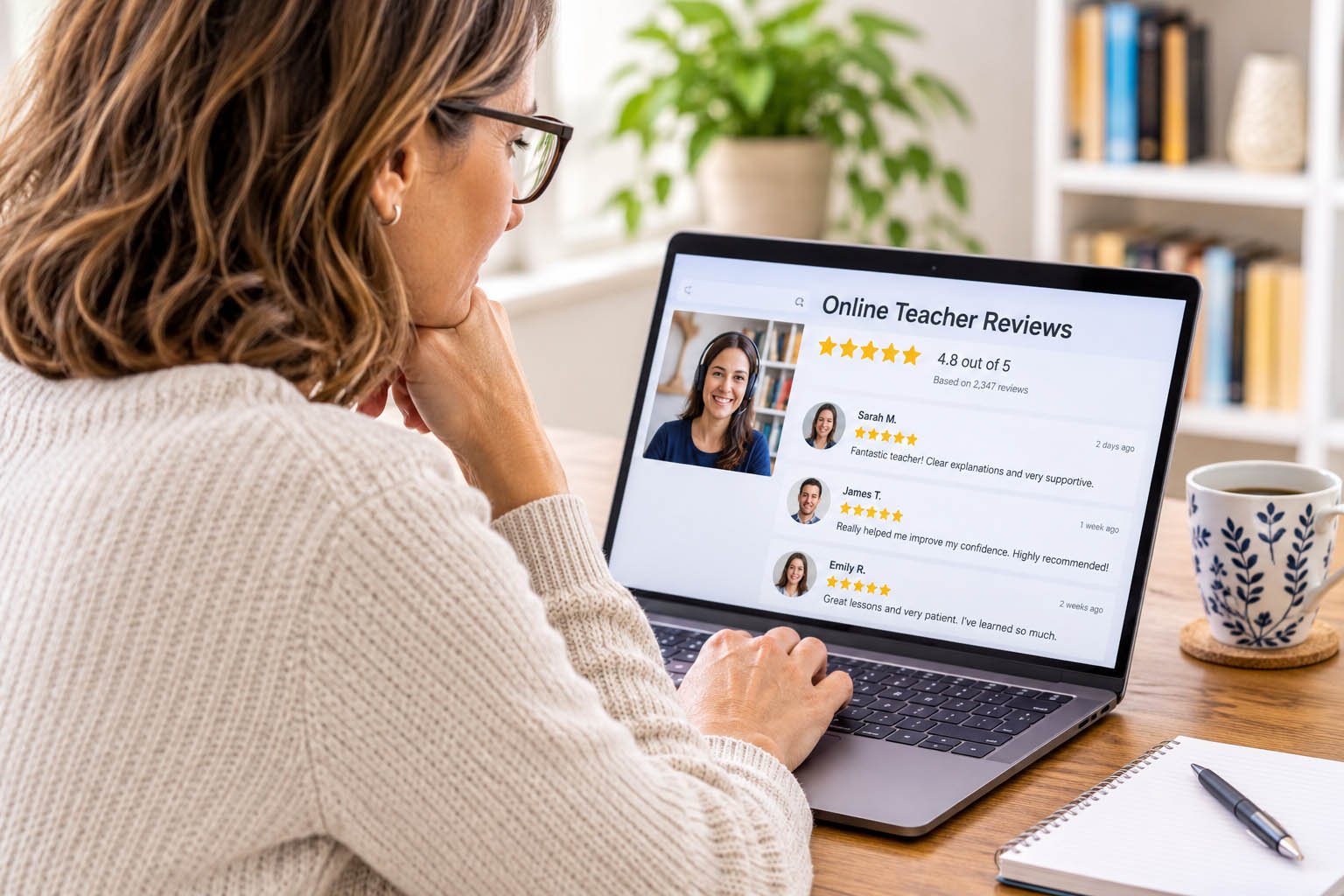
You’ve found three or four online teachers who look right. Their prices are similar, their profiles all sound friendly and qualified, and you can’t meet any of them before you book. So you turn to the reviews.
Online teacher reviews are one of the best guides you have, but only if you know how to read them. A page of five-star ratings can tell you less than two thoughtful comments from people with the same goal as you.
This guide explains where to find reviews, what makes a review genuinely useful, the warning signs worth noticing, and what to do when a good teacher simply hasn’t collected many yet. If you’re booking lessons for a child, there’s a section for you too.
Where to find online teacher reviews
Reviews of the same teacher can sit in several places, and each tells you something slightly different.
The teacher’s own website
Testimonials here are chosen by the teacher, so expect the best ones. That’s normal, and they can still be very useful if they are specific.
Teachers who also see students in person, at a studio or in local classes, may have a Google Business Profile with reviews.
Independent review sites
Some review sites let anyone leave feedback, and the teacher can’t pick which reviews appear.
LinkedIn and Facebook
Professional trainers and coaches often have recommendations on LinkedIn, which show the writer’s name and job.
Good to know
Don’t treat a missing Google profile as a warning sign. Google only allows Business Profiles for businesses that meet customers face to face, and its eligibility guidelines exclude online-only businesses. A teacher who teaches only online can’t have one, so they won’t have Google reviews either.
What makes a review worth trusting
The star rating is the least useful part of most reviews. These are the things that tell you whether a teacher is right for you.
1. Specific detail
‘Great teacher, highly recommend’ is pleasant but tells you little. Look for reviews that describe what actually happened: how lessons were structured, how the teacher explained a tricky point, or what the student could do afterwards. Detail is hard to fake and gives you a real picture of the teaching.
2. Someone like you
A glowing review from an advanced student may not help if you are a complete beginner. Look for reviewers with a similar goal, level or situation, such as preparing for an exam, learning for work, or a parent booking for a teenager. The most useful review is the one written by someone in your position.
3. Recent reviews
Teachers change their lessons, prices and availability over time. Reviews from the last year or so tell you more about what you will get now than ones from several years ago.
4. Reviews spread over time
A steady flow of reviews over months or years suggests a teacher with a consistent stream of students. Several reviews appearing on the same day is not proof of anything, but it is worth noticing alongside other signs.
5. How the teacher replies
If a teacher responds to reviews, read the replies, especially to critical ones. A calm, polite answer that takes the point seriously tells you a lot about how they would handle a problem with your lessons.
6. Patterns across reviews
One review is one person’s experience. When several reviewers independently mention the same thing, such as patience, clear explanations or lessons that often start late, it is probably true.
Warning signs to notice
Most reviews are written by real students in good faith. Still, a few things are worth a second look:
- Reviews that all sound the same: similar phrases, similar length and no real detail about the lessons.
- Reviews that mention a reward, such as a free lesson or discount for leaving one. Google bans businesses from offering incentives for reviews, and in some countries consumer law requires any incentive to be disclosed. A rewarded review may still be honest, but it is weaker evidence.
- Reviews that don’t fit the teacher, for example praising a subject or service they don’t offer.
None of these proves anything on its own. Treat them as a reason to ask the teacher more questions, not as a verdict.
Keep a bad review in proportion
A single critical review among many good ones is not a reason to rule a teacher out. In fact, a profile with only perfect scores can be less believable than one with the occasional honest complaint.
Read what the complaint is about. A one-off scheduling mix-up across time zones is different from repeated comments about poor preparation. Then read the teacher’s reply, if there is one. How a teacher responds to criticism often tells you more than the criticism itself.
When a teacher has few or no reviews
Every teacher starts with none. Someone who has recently moved their teaching online, or only just started collecting feedback, may be excellent and simply not have many reviews yet. When you browse our Teacher Directory, you’ll find teachers at every stage.
In that case, gather your own evidence:
- Ask about their experience. How long have they taught this subject, and to which levels or age groups?
- Ask whether a past student would be happy to talk to you, or whether they can share feedback they have permission to pass on.
- Book a trial lesson if one is offered. A trial lesson is a short first session, sometimes free or reduced, where you can see how the teacher works before committing.
- Start small. Book a few lessons rather than a large block until you know it’s working.
The best review of all
Your own first lesson is the most reliable review you’ll ever read.
Pay attention to how prepared the teacher is, how well they listen to what you want, and how you feel at the end.
For parents: what reviews can’t tell you
Reviews from other parents are valuable. They often mention things a child wouldn’t, like whether the teacher kept in touch about progress or adapted lessons when a child lost confidence. Look especially for reviews from parents of children around the same age as yours.
But reviews are not a substitute for your own checks. Before booking, it’s reasonable to ask any teacher:
Ask any teacher
- whether you can be present, or nearby, during lessons
- whether lessons are recorded, and who can see the recordings
- how messages are handled, for example whether they go through you rather than directly to your child
- what background checks they hold, if any
Good teachers expect these questions and are happy to answer them. Background checks and safeguarding rules vary from country to country, so check your own government’s or education authority’s guidance on choosing a private tutor for your child.
Leaving a helpful review yourself
Once you’ve had a few lessons, your review can help the next person in your position. The most useful reviews are honest and specific:
- what you wanted to achieve and your starting level
- what the lessons were like and what worked for you
- anything that could be better, said fairly
You don’t need to write much. Three or four sentences with real detail help other learners far more than a row of stars. If a teacher offers you a discount or free lesson in return for a review, you can politely say no and simply leave an honest one if you wish.
Teaching online?
Teachers reading this can find the other side of the story in our guide, Why Reviews Matter for Online Teachers and How to Get Them.
Frequently asked questions
Is a high star rating enough to go on?
It’s a starting point, not a decision. Two teachers with the same average can be very different, so read a handful of the written reviews, including the most recent and the most critical, before you choose.
Can a teacher delete bad reviews?
On Google, a business can’t simply delete a review. It can report a review it believes breaks Google’s policies, and Google decides whether to remove it. On a teacher’s own website, though, the teacher chooses which testimonials to show, so it’s worth reading reviews elsewhere too.
Should I trust testimonials on a teacher’s own website?
Yes, as long as you read them for what they are: a selection of the teacher’s best feedback. Specific, detailed testimonials with a first name, subject or country are more convincing than anonymous one-liners.
The teacher has great reviews but I didn’t enjoy my trial lesson. What now?
Trust your own experience. Reviews tell you how a teacher worked for other people, and teaching styles suit different learners. It’s fine to thank the teacher and try someone else.
Checklist: reading reviews before you book
- Read the written reviews, not just the star rating
- Look for specific detail about the lessons
- Find reviewers with a similar goal, level or age to you or your child
- Check that some reviews are recent
- Notice whether reviews are spread over time
- Read the teacher’s replies, especially to criticism
- Look for patterns rather than one-off comments
- Don’t rule out a teacher just for having few reviews or no Google profile
- Parents: ask about supervision, recordings, messages and background checks
- Book a trial or a few lessons first, and trust your own experience
Final thoughts
Reviews are most useful when you read them like a careful friend would: looking past the stars for detail, for people like you, and for how the teacher handles the occasional problem. Use them to build a shortlist, then let a conversation and a first lesson make the final call.
Ready to compare?
Find a teacher who suits you
When you’re ready to start comparing, search by subject, language or skill to find teachers and courses that suit you.